
I’ll start with a confession: when people first hear “psycho-spiritual coaching”, they often imagine incense, crystals, and someone telling you your “third eye” is blocked. And… look, that can exist in the wider spiritual marketplace. But psycho-spiritual coaching (when it’s grounded in psychosynthesis) is usually much more ordinary and practical than that. It’s more like: “How do I live as the fullest version of myself, without pretending I don’t have messy emotions, protective habits, and an occasionally panicky nervous system?”
Psychosynthesis gives you a map for doing that—without reducing you to a diagnosis, and without bypassing the real world.
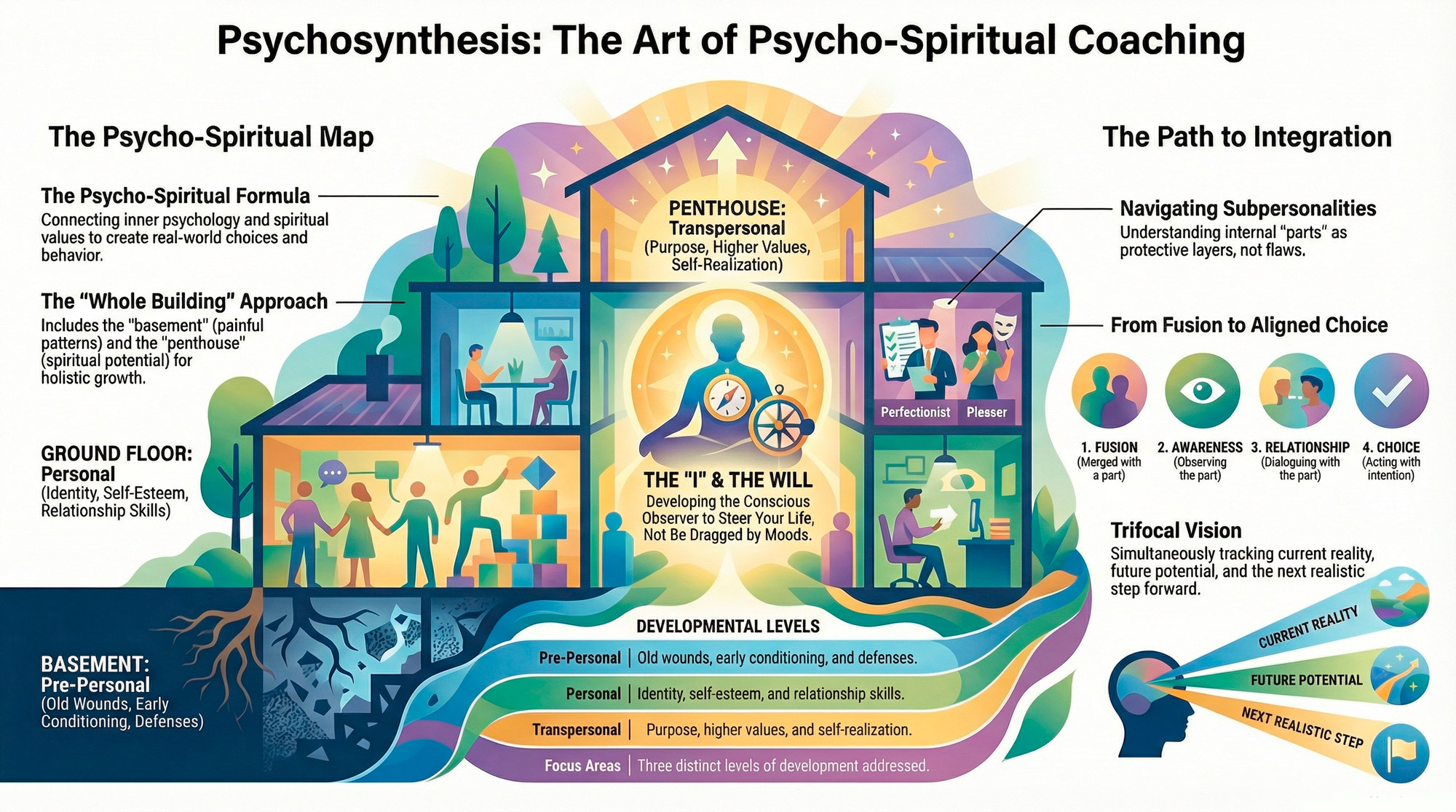
At its simplest, psycho-spiritual coaching is coaching that includes your inner life and your deeper purpose, not just your external goals and performance. It still cares about action and outcomes, but it also cares about meaning, identity, values, and the quieter “something” inside that knows when you’re living out of alignment. Psychosynthesis is explicitly built to include the whole building, not just the “basement” (the painful stuff) or the “penthouse” (peak spiritual states). It’s holistic on purpose.
A normal-life definition you can actually use
Psycho-spiritual coaching helps you understand what’s going on inside you (psychological), connect with what matters most to you (spiritual), and then turn that into real choices and behaviour in your actual life (coaching).
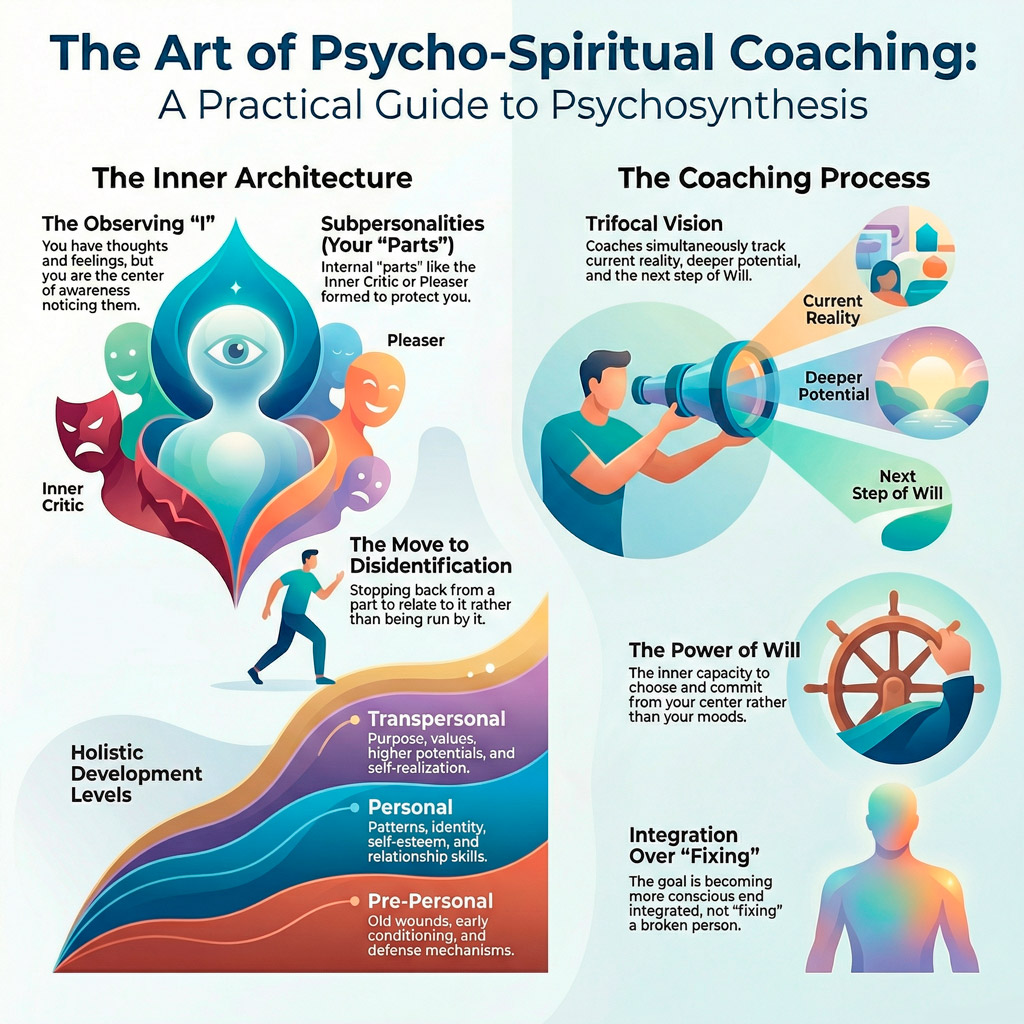
It’s not therapy. It can feel deeply healing, sure—but the contract is different. You’re not there to be “fixed”. You’re there to become more you—more conscious, more integrated, and more able to choose how you show up. Psychosynthesis talks about developing a stronger sense of the “I” (the conscious self) and the Will—the part of you that can steer, rather than be dragged around by moods, fears, or old patterns.
The psychosynthesis lens: “You are not your thoughts… and also you’re not a floating spirit”
One of the most relieving ideas in psychosynthesis is this: you have thoughts, feelings, roles, impulses, and habits—but you are not only any of those things. There’s also an observing centre, a “someone” who can notice it all. Psychosynthesis calls this the “I” (conscious self), and it treats that “I” as a centre of awareness and will.
That’s where a lot of psycho-spiritual coaching starts—not with “what should you do?”, but with:
- “Who is noticing this?”
- “What part of you is speaking right now?”
- “What becomes possible when you’re not fused with that part?”
This is the spirit of disidentification: stepping back from whatever has grabbed the steering wheel (anxiety, perfectionism, people-pleasing, anger, collapse) so you can relate to it rather than be it.
“Parts work”, psychosynthesis style: subpersonalities (and why it’s not weird)
Most people already know this experience:
- Part of me wants to go for the promotion.
- Part of me wants to hide under a duvet and never be perceived again.
- Part of me says, “Be nice, don’t rock the boat.”
- Another part says, “I’m furious, and I’m done.”
Psychosynthesis calls these subpersonalities—semi-organised “parts” of the personality that formed for good reasons (usually protection, belonging, approval, control, survival). The work isn’t to exile them. It’s to bring them into awareness, understand their positive intent, and integrate them so your life isn’t run by an internal tug-of-war.
Sometimes this is done through dialogue and reflection; sometimes through imagery exercises (psychosynthesis uses imagination in a very practical way).
The “spiritual” bit: not religion, more like depth, meaning, and Self
In psychosynthesis, “spiritual” doesn’t have to mean religious. It often means:
- the search for meaning and purpose
- moments of intuition, conscience, clarity, compassion, awe
- the sense that your life wants to be about something larger than just coping and performing
Psychosynthesis holds a developmental view: we can work at pre-personal (old wounds, defences, early conditioning), personal (patterns, identity, self-esteem, relationships, skills), and transpersonal (purpose, values, higher potentials, self-realisation).
And importantly: it’s not “skip the messy bits and ascend”. It’s more like: include everything, integrate, and then live from a deeper centre.
What actually happens in psycho-spiritual coaching sessions?
A psychosynthesis-informed coach is usually tracking three things at once:
- your current reality (what’s happening, what’s stuck)
- your deeper potential (who you’re becoming, what qualities are emerging)
- the gap between the two—and what step your Will can realistically take next
That’s often called Trifocal Vision—and it’s a deceptively simple way to keep sessions grounded in real life and oriented toward growth.
There’s also a big emphasis on how the relationship itself is held—presence, respect, and a kind of “I–Thou” relating (human-to-human, not expert-to-problem). Psychosynthesis coaching training calls this Conscious Relations / Right Relations, and it’s basically the art of listening and relating in a way that helps the client feel met—without being controlled, fixed, or analysed into submission.
And then, yes, there’s still structure. Many psychosynthesis coaches still use something GROW-like (Goal, Reality, Options, Will), but with a wider lens—so the “Will” part isn’t just motivation, it’s the deeper capacity to choose and commit from your centre.
What psycho-spiritual coaching is not (and why that matters)
A few clean boundaries help keep it trustworthy:
- Not therapy: if someone is in acute trauma overwhelm, severe mental health crisis, or needs clinical treatment, ethical coaching refers out and/or works alongside therapy. (Psychosynthesis coaching can touch deep material, but it’s held with care and scope.)
- Not “positive vibes only”: psychosynthesis explicitly includes the lower unconscious and the hard emotions, without making them the whole story.
- Not fortune-telling: intuition is respected, but it’s tested against reality and responsibility.
- Not fixing: the aim is integration, choice, and aligned action—not “becoming a perfect person”.
Why people seek it out (the real reasons)
In practice, clients come for things like:
- “I keep repeating this pattern, and I don’t know why.”
- “I’m successful on paper, but I feel empty.”
- “I can’t say no—then I resent everyone.”
- “Something in me is changing, and I don’t have language for it.”
- “I want to lead from a deeper place, not just performance and pressure.”
Psychosynthesis is good here because it gives you a way to work with the pattern underneath the pattern: the parts involved, the belief system, the nervous system cues, the meaning, and the next act of Will.
A tiny “try it now” taste (safe, simple, and non-weird)
If you want a quick flavour of psychosynthesis without committing to anything dramatic, try this:
- Think of a situation where you feel stuck.
- Ask: “What part of me is most active here?” (e.g., the Pleaser, the Controller, the Avoider, the Inner Critic).
- Then ask: “If this part had a positive intention, what would it be trying to protect?”
- Finally: “What would my ‘I’ choose if it could hold this part kindly, without being run by it?”
That’s the whole move: from fusion → awareness → relationship → choice. It’s the beginning of synthesis.
(If you like structured exercises, psychosynthesis has loads of journaling practices, “Who am I?” inquiry, guided imagery like the Rose Garden, and more.)
A closing thought
I think the heart of psycho-spiritual coaching is this: it treats you as more than your problems, and also more than your lofty ideals. It assumes there’s something wise in you and something protective in you, and both deserve a seat at the table. Then it helps you build the inner capacity to lead your life from the centre—steadily, imperfectly, and with meaning.
Also read:
Follow me on LinkedIn

